
Archive for the ‘Investment Loans’ Category

Self Managed Super Funds And Property Investment: Information You Need To Know

May 17th, 2012 No Comments
Posted by admin

What is an SMSF?

A Self Managed Super Fund is a trust you use in order to manage your own superannuation. Basically instead of the employer provided super fund, you have direct control over your assets. This enables you to choose where you invest your money for your retirement. You can put the money in a number of different places including capital investments such as shares and property. Each different investment comes with a variety of risks.

What laws and restrictions will affect investing in property?

Whilst is is possible to use your fund to invest in property, there are certain laws and restrictions that can affect your eligibility and limit the options you have available. Some examples of the legal conditions under which an SMSF can borrow money include;

  • The asset is an asset that the SMSF (you) could legally otherwise acquire if it had available funds
  • A security trust (security custodian) holds the asset until all repayments are made.
  • Once all repayments have been made the SMSF must have the right to acquire legal title of the asset from the Security Trustee

How much you can borrow with these loans differs from normal mortgage applications. Standard investment loans are offered at up to 80% of the property value however lenders usually restrict the amount to 72% or 75%.

It is also important to note that loc doc loans are not available and the fund must be able to prove it can repay the loan.

Which banks and lenders can help and what interest rates are available?

Many banks are not willing to lend to SMSFs. They believe that the loans are more complex and lead to less profit. However there are a number of lenders that do not see it this way and are willing to assess an application. These can be difficult to find however without professional help from a mortgage broker.

Interest rates for SMSF loans are higher than for normal property purchases. Depending upon your circumstances and the risks the lenders perceive, low interest rates may be available. However as there are large differences in pricing between the major lenders this depends largely upon which bank you apply to.

What are the risks associated with investing in property this way?

Property is what is called a capital growth investment and can be useful for capital gains and tax benefits using negative gearing and depreciation allowances. However as the global financial crisis showed, value can fall from time to time possibly leading to large capital losses.

As for cash flow, the property may be vacant or tenants may not pay rent and you may default on your repayments. If the situation arises where you need money it is also difficult to sell quickly at a high price.

How Should I Apply?

Applying for a loan on your own can be difficult. There are not too many lenders willing to lend to SMSFs and each declined application will affect your eligibility next time around as it will go on your file. Even if you find a lender yourself, such as your current bank, you are unlikely to be offered the lowest interest rate.

Applying through a mortgage broker that works with many different lenders and specialises in different loan types such as SMSF loans, is the safest option. As they know the lending criteria of the banks they are aware of who offers these loans, where you may be eligible to apply and who may have the lowest interest rates.

The National Rental Affordability Scheme – Investor Benefits

April 26th, 2012 No Comments
Posted by admin

National Rental Affordability Scheme InvestorWhat is NRAS?

In 2008, the Australian Federal government along with commitments from states and territories initiated the National Rental Affordability Scheme (NRAS). NRAS legislation represents a long-term plan aimed to provide new rental housing to low and moderate-income earners at affordable costs.

Under the NRAS, potential investors are urged to buy a NRAS approved dwelling and agree to rent the property out at 20% below the local market home rental rate.

As an incentive to encourage large-scale investment in NRAS approved properties, the government offers either a grant or a tax exemption for up to 10 years. Based on present criteria, the Australian Government has identified more than 1.5 million national households as potential tenants eligible for NRAS assistance.

What are the Incentives?

The National Rental Affordability Scheme is a national opportunity for a property investment that provides financial incentives that combine both a potential real gain and a tax rebate. Investing in an NRAS approved property can currently provide up to almost $10,000 in state and national tax tree incentives.

The NRAS agreement is secured for 10 years, but the property must remain approved for the benefits to continue. When the agreement ends, the investor is free to on-sell the property or rent it out at market value. Prior termination will incur a penalty unless the buyer agrees to continue the obligations under the NRAS agreement.

Investing in a NRAS Property

NRAS is aimed at large scale not individual investment. Obtaining NRAS approval of properties and maintenance of that approval is complicated legal process. Consequently, investors usually purchase an NRAS approved dwelling from a NRAS approved consortium.

Consortiums consist of two or more investors that purchase or construct a home development that will meet the NRAS requirements. Consortiums can take different legal forms. Non-Entity Joint Venture, Head Lease Structured and Real-Estate Delivery Agreement Consortiums are most common.

Typically, the consortium provides the funds to finance a housing development and obtains NRAS approval. The individual investor then purchases one or more of these properties as their investment and gains the benefit of the NRAS incentives and any future potential property sale. Usually the consortium maintains the property. The individual is responsible for claiming their NRAS tax rebate in their tax return.

How to Finance a NRAS Investment Purchase

Finding a loan to finance a purchase through consortium can present difficulties. Experienced national mortgage brokers that specialise in NRAS approved properties can assist the investor in obtaining financing based on their income, employment, property type and property location.

Getting approval for a loan largely depends on how banks and lenders view NRAS properties and the particular consortium through which an investor chooses to invest. Banks and other lenders investigate the legal structure and contractual policies of consortiums with their investors and determine how the policies impact the security position of the property. After evaluation some lenders may label certain NRAS consortiums as high-risk investments.

Although some banks and lenders approve many consortiums with a “headlease” structure, many lenders favour consortiums that are structured as non-entity joint ventures. Every investor should consult with their financial advisers and mortgage brokers to determine the right product for them.

A mortgage broker can help you finance your loan

A mortgage broker experienced in obtaining loans for NRAS properties will know the NRAS consortiums and their potential lenders. Additionally, the broker can help frame an investor’s application in the most favourable light for their situation and the lending guidelines of the banks.

The broker can work with banks to obtain a mortgage with a Loan to Value Ratio (LVR) of up to 90% plus Lenders Mortgage Insurance (LMI). In some cases, lenders can be found that will consider a portion of the tax incentive in assessing the investor’s ability to repay the loan.

Self Managed Super Fund Loans

February 20th, 2011 1 Comment
Posted by admin

SMSF investorDo you have approximately $150,000 in your Superannuation? If you do, you may be eligible for a Self-managed superannuation fund (SMSF) loan to purchase real estate with your Super!

A vast number of major mortgage brokers and bank managers do not understand SMSF Loans as they are complex and they do not deal with them on a daily basis. This means that errors can be made, and loans declined purely because of their lack of understanding; as such it is strongly advised that you seek expert advice when considering Self Managed Super Fund borrowing.

There are also significant differences between policy and pricing between different banks, so speaking to a specialist mortgage broker such as The Home Loan Experts will ease the confusion that you would face dealing with the different financial institutions directly. You can find out more about their services on their Self Managed Super Fund Loan information page.

What are the benefits to borrowing in your fund?

Since the Superannuation Industry Supervision Act 1993 (SIS ACT) was amended in September of 2007, Funds now have the ability to borrow for Property Investments. This allows DIY Super Funds to take advantage of the same benefits as regular property investors.

Below are some of the benefits available to SMSF loans: (Please note: SMSF loans are also commonly referred to as Warrant Trust Loans, Instalment Warrants or SMSF Trust Loans.)

  • Reduces tax rate on rental income to 15%
  • Tax advantages on sale of investment property
  • Super Funds are able to purchase property worth more than it’s available funds through the benefit of gearing
  • You can use income from the security to help pay off the loan
  • Extensive tax deductions can be claimed by the Super Fund
  • Funds receive all income and capital growth, even if the property has not been paid off as yet
  • Superannuation assets are secure, as the lender does not have recourse to the SMSF’s other assets in the event of default

How do I purchase a property with my SMSF?

Self-managed Superannuation Funds can choose any type of property as investment; these investment properties include Commercial, Residential, Holiday Units and Retail. However, you must ensure that the property complies with the SIS ACT, the SMSF’s overall investment strategy (Superannuation funds must have a written investment strategy in place), and that the Fund has sufficient equity to complete the purchase.

Here are some basic guidelines as to how a SMSF purchases a property: (Please Note: The SMSF must purchase property from an unrelated party. Purchases must be at arm’s length.)

  • Establish your SMSF – The Trust Deed establishing the fund must have the power to Purchase Real Estate, Borrow Money, and Mortgage Property to secure payment of that borrowing
  • Obtain a loan approval – it is recommended to obtain a Pre-Approval on your Superannuation Fund before paying your deposit
  • Establish the property Trust Deed – this is something that your accountant or financial adviser will need to create. It is also important that the SMSF Trustee itself is not the Property Trustee, nor are the individual member of the SMSF are to act as Property Trustee – as this will breach the regulations of the SIS ACT
  • Exchange of Contract – deposit to be paid from Superannuation Fund
  • Formal Approval – Once Valuation on security is completed the lender will issue a Formal Approval
  • Loan Documents Issued – The lender will have their solicitor prepare loan documents and issue to you
  • Settlement – On completion of the purchase the Property Trustee mortgages the property to the lender

How is the loan structured?

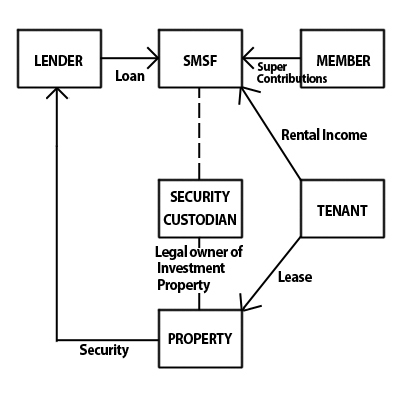
The property itself is owned by a security trustee. You can click on the below picture for a detailed flowchart of how the mortgage & ownership of the property will be setup.

SMSF Trust Structure

What are the features of a Super Fund Loan?

  • Members of the SMSF are unable to reside in the investment residential property – however they can do so after retirement, providing it is transferred from the SMSF before hand
  • The lender has no recourse to the other assets of the Super Fund, providing the SMSF with absolute protection for its other assets
  • The Super Fund receives the income from the investment property
  • The legal owner of the real estate will be the Property Trustee
  • The beneficial owner of the real estate is the Super Fund
  • The Fund can make any adjustments to the property as it sees fit (e.g. Lease, renovate, repair, or sell) providing this is in conjunction with the loan terms
  • The SMSF has the ability to reduce or pay out the loan at any time (subject to the terms and conditions of the lender and loan)
  • After the loan is repaid to the lender the legal ownership of the security will be transferred to the Super Fund – repayments of the loan are made from the SMSF

Compare Lenders

Below is a quick comparison of the policies used by some the major lenders we deal with for super fund loans:

Lender 1:

  • Repayments: Principal & Interest
  • Loan Term: 30 years (residential), 15 years (commercial)
  • Maximum loan size: $4,000,000
  • Maximum LVR: 80% (residential), 65% (commercial)
  • Security: Residential or commercial

Lender 2:

  • Repayments: Principal & Interest
  • Loan Term: 25 years (residential), 15 years (commercial / rural)
  • Maximum loan size: $5,000,000
  • Maximum LVR: 80% (residential), 60% (commercial), 50% (rural)
  • Security: Residential, commercial or rural

Lender 3:

  • Repayments: Principal & Interest (fixed rates available)
  • Loan Term: 30 years (residential)
  • Maximum loan size: $500,000
  • Maximum LVR: 80% (residential)
  • Security: Residential

Seeking advice – how important is it really?

There are number of rules and regulations regarding establishing a Self-Managed Superannuation Fund and planning for your retirement.

As such it is highly recommended that you seek professional advice by selecting a qualified accountant, and a specialist mortgage broker. You can find out more about borrowing in your super fund the Home Loan Experts SMSF Trust Loan page.

It goes without saying that you should obtain professional tax and legal advice before establishing your own Super Fund, purchasing a property in a fund or applying for a mortgage with your fund.

SEPP 5 finance

October 12th, 2010 No Comments
Posted by admin

What is Sepp 5 zoning?

A Sepp 5 development is a specialized block of units, townhouse estate or village where the occupants are restricted to be either over the ages of 55, pensioners, disabled or elderly couples. These developments have approval from the local council to build more units on a block of land then what is usually allowed, this means the cost of each unit to build and sell is cheaper than the same type of units in the same area. This way it can be marketed better to the baby boomer generation.

These developments have been specifically designed to assist the day to day living for elderly people who require certain features for example:

  • Access ramps in ever building
  • In area medical centre
  • Specialized bathrooms
  • Larger doorways
  • Public transport which comes straight to the development
  • Meal deliveries
  • Community activities
  • Community with people of similar ages
  • Low maintenance security upkeep

A Sepp 5 development is different to a retirement home, it is an independent living accommodation where the occupants has ownership of each separate title and there is no in-house nurse, there is no set time for dinner and activities. It is an over 55s friendly environment where the occupant is free to do what they please and is self reliant.

Why Invest in a Sepp 5 Security?

The reasons for purchasing a Sepp 5 accommodation to live in have been outlined above; the reasons for investing in one are below:

  • Excellent rental yield
  • Good price – for the price of the same unit dimensions unit in the same area Sepp 5 is generally cheaper
  • Usually located in growing areas within 10 mins from major cities
  • Usually cash flow neutral or positive

How can I apply for a Sepp 5 home loan?

Sepp 5 or over 55 securities are only taken on as standard securities by less than a hand full of financial institutions, depending the where the security is and the loan amount. Most banks are uncomfortable in lending against these securities as they believe that is harder to resell as it is a restricted market.

It is best to contact a specialist Mortgage Broker who deals in these kind of scenarios on a daily basis. You will have to show that you can afford to make repayments and have ongoing cash flow. Unfortunately if you are retired and on the pension then this will restrict the size of the loan that can be approved. However investors buying these properties to rent out can get approval for a mortgage.

About the Author

Otto is a Mortgage Broker that has specialised in the credit guidelines of the major banks for over 7 years. His company the Home Loan Experts is now one of the top home loan broking firms in Australia. You can refer to their main website for more information about financing over 55s or Sepp 5 properties.

90% Home Loans for Investments

April 15th, 2010 No Comments
Posted by iggy

Investments, Home LoansInvesting in a foreign country is always risky.  The business and mortgage practices are different, and you are not familiar with how stable that country is.  For ‘would be’ investors in Australia there are a host of possible opportunities for purchasing real estate that can really earn you back your investment and make you some profits.

This means that you may require our help in deciding which property should be a worthwhile purchase. With so many options available it can become very confusing. What is even more confusing is the range and variety of lenders who may try to take advantage of the limited knowledge as a new investor in a foreign land. This can be avoided by working with us as we have contacts with many trusted banks and lenders that we can tailor fit a 90% home loan for you.

Due to the fact that it is a 90% home loan the investor would of course be required to deposit a certain amount in order to have your home loan approved.  Without the deposit you will generally not be allowed to get a loan.  However, in some exceptional circumstances where other property is likewise mortgaged, there is a good chance that you will be able to get a good deal on the loan.

The nice thing about the 90% loan is that you need not have genuine savings available to apply for it and get approved.  A gift from a relative will do in order to do away with the requirement of genuine savings.  You may need a gift letter to encourage the banks to approve the loan, but this is a generally accepted practice.

Some would like the possibility of getting a 100% home loan, and this is very possible only if some other person is willing to act as guarantor of the person applying for the loan.  With the help of a guarantor, finally deciding on the 90% home loan would be much easier.

Purchase Australian Property with FIRB Approval

April 15th, 2010 No Comments
Posted by iggy

There are a lot of instances when purchasing property in Australia has its benefits.  This is true whether you are a foreigner or an Australian citizen.  Investing in property and real estate and Australia is often low risk as value of property is constantly on the rise.

However certain steps must be taken before a loan can be made.  First and foremost Foreign Investment Regulatory Board (FIRB) approval is often necessary unless you fall under the exceptions.  There are several exceptions.

First and foremost an Australian citizen living approval does not need FIRB approval.  Where your spouse is Australian, and you are purchasing a house to live in as joint tenants you likewise need not ask for FIRB approval.  Residents of New Zealand are likewise exempt, and if you hold a permanent resident visa you need not seek any approval.

Temporary residents on the other hand are exempt when purchasing single blocks of vacant land, or new dwellings.  Purchasing a second hand dwelling to live in is also exempt, or even purchasing new dwelling as long as they are pre approved to be sold to foreign citizens.

If you fall within these exemptions, that is one less process to worry about.

Whether or not you need FIRB approval is one thing, while another item for those trying to get a loan is how much of a loan they can get.  Australian citizens living abroad can generally get up to 95% LVR with LMI.  This is the same maximum for those with foreign spouses either working abroad or working in Australia.  Temporary residents working in Australia on the other hand can get up to 85% LVR, while foreign nationals who live and work abroad can get up to 80% of the total property value.

Investing and buying real estate is a genuine opportunity to make a wise investment.  As long as all the requirements such as FIRB approval and the necessary documents are submitted, it shouldn’t be hard at all for a foreigner to get a loan to purchase the property they would like in Australia.

Easy Access to Student Housing

March 26th, 2010 No Comments
Posted by iggy

When you have kids, they often live with you their entire lives, then when you see them off to college, they will slowly become more independent and want a life apart from you.  Of course parents will have a hard time letting go, but that is what parents do.  They want the best for their children and seek to provide only what is good for them their entire lifetime.

For some parents, one of the best gifts they could give their children  during their college days is a decent place to stay so they can hone and develop their talents without needing to worry so much about their living space.  This is the reason why some of them buy instead of rent student housing for their child.  That way they can really choose a student housing that is to their liking, and their child has the privacy that a budding university student requires.

For some of these parents, funding may not be a problem at all, and paying for student housing may be just part of an incidental investment plan when their children finish their course in the university.  For others, it is not this simple.  Some parents may not even be able to afford student housing, so they may have to apply for a loan in order to be able to purchase such property.

The problem is that not many banks or lenders would grant a loan for student housing or student accommodations.  For one, student accommodation is seasonal, so if it is bought for investment, the rentals and lease usually happens only the school season, and the housing is empty during the holidays.  Another risk that lenders and banks refuse to take is the fact that these types of housing may be difficult to dispose of in case the borrower is unable to make the required repayments.

For more information on purchasing student housing, it would be best to consult the experts on home loans.  They can advise you as to which banks or lenders will be more than willing to grant your home loan application for student housing.  They will also ensure that you get the best loan package available as not all loans are created equal.  With their help, you should be well on your way to buying the student housing to suit your child’s needs.

Investing in Real Estate Down Under

March 26th, 2010 No Comments
Posted by iggy

There is no question that Australia is a land of opportunity.  The huge continent is home to a small population that has yet to fully take advantage of the country’s real estate potential.  Recent news suggests that the housing market in the United States has hit an all time low, with housing prices and purchasing down and out. This makes Australia an ideal alternative to invest in. The diversity of the country and the constant rising prices of real estate, the rich natural resources, and the diverse and beautiful areas to choose from make Australia an ideal option for multiple investments in real estate.
The nice thing about this fact is that foreigners may freely invest in Australia, all they need is government approval and once this is granted then investing may be done. There are various options available to potential investors. The choices of investments can range from purchasing vacant land, multiple units on one title, off the plan units, student accommodations, dual occupancy units, hotel conversions, and all the way through to mining towns.
These numerous options are what make Australia a great place to invest in and the property value will vary greatly depending on what type you choose to invest in. This means that the price of the property can range from very cheap to extremely expensive.
For more information on possible real estate investments in Australia, it would be best to consult the experts on home loans.  They have the information on the best possible investments and with the most potential for real estate.  They can also custom fit certain loan products to your capacity to invest and the amount of risk that you are willing to take.