





Home Loan Rate

Talk to the rate specialists!
read more

Self Managed Super Fund Loans

February 20th, 2011 1 Comment
Posted by admin

SMSF investorDo you have approximately $150,000 in your Superannuation? If you do, you may be eligible for a Self-managed superannuation fund (SMSF) loan to purchase real estate with your Super!

A vast number of major mortgage brokers and bank managers do not understand SMSF Loans as they are complex and they do not deal with them on a daily basis. This means that errors can be made, and loans declined purely because of their lack of understanding; as such it is strongly advised that you seek expert advice when considering Self Managed Super Fund borrowing.

There are also significant differences between policy and pricing between different banks, so speaking to a specialist mortgage broker such as The Home Loan Experts will ease the confusion that you would face dealing with the different financial institutions directly. You can find out more about their services on their Self Managed Super Fund Loan information page.

What are the benefits to borrowing in your fund?

Since the Superannuation Industry Supervision Act 1993 (SIS ACT) was amended in September of 2007, Funds now have the ability to borrow for Property Investments. This allows DIY Super Funds to take advantage of the same benefits as regular property investors.

Below are some of the benefits available to SMSF loans: (Please note: SMSF loans are also commonly referred to as Warrant Trust Loans, Instalment Warrants or SMSF Trust Loans.)

  • Reduces tax rate on rental income to 15%
  • Tax advantages on sale of investment property
  • Super Funds are able to purchase property worth more than it’s available funds through the benefit of gearing
  • You can use income from the security to help pay off the loan
  • Extensive tax deductions can be claimed by the Super Fund
  • Funds receive all income and capital growth, even if the property has not been paid off as yet
  • Superannuation assets are secure, as the lender does not have recourse to the SMSF’s other assets in the event of default

How do I purchase a property with my SMSF?

Self-managed Superannuation Funds can choose any type of property as investment; these investment properties include Commercial, Residential, Holiday Units and Retail. However, you must ensure that the property complies with the SIS ACT, the SMSF’s overall investment strategy (Superannuation funds must have a written investment strategy in place), and that the Fund has sufficient equity to complete the purchase.

Here are some basic guidelines as to how a SMSF purchases a property: (Please Note: The SMSF must purchase property from an unrelated party. Purchases must be at arm’s length.)

  • Establish your SMSF – The Trust Deed establishing the fund must have the power to Purchase Real Estate, Borrow Money, and Mortgage Property to secure payment of that borrowing
  • Obtain a loan approval – it is recommended to obtain a Pre-Approval on your Superannuation Fund before paying your deposit
  • Establish the property Trust Deed – this is something that your accountant or financial adviser will need to create. It is also important that the SMSF Trustee itself is not the Property Trustee, nor are the individual member of the SMSF are to act as Property Trustee – as this will breach the regulations of the SIS ACT
  • Exchange of Contract – deposit to be paid from Superannuation Fund
  • Formal Approval – Once Valuation on security is completed the lender will issue a Formal Approval
  • Loan Documents Issued – The lender will have their solicitor prepare loan documents and issue to you
  • Settlement – On completion of the purchase the Property Trustee mortgages the property to the lender

How is the loan structured?

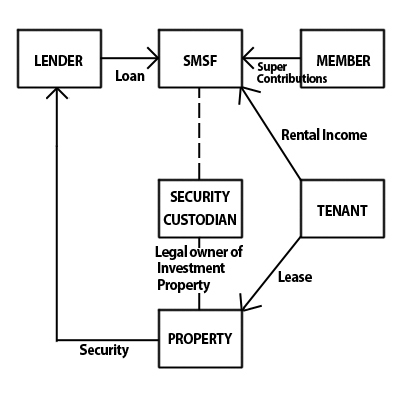
The property itself is owned by a security trustee. You can click on the below picture for a detailed flowchart of how the mortgage & ownership of the property will be setup.

SMSF Trust Structure

What are the features of a Super Fund Loan?

  • Members of the SMSF are unable to reside in the investment residential property – however they can do so after retirement, providing it is transferred from the SMSF before hand
  • The lender has no recourse to the other assets of the Super Fund, providing the SMSF with absolute protection for its other assets
  • The Super Fund receives the income from the investment property
  • The legal owner of the real estate will be the Property Trustee
  • The beneficial owner of the real estate is the Super Fund
  • The Fund can make any adjustments to the property as it sees fit (e.g. Lease, renovate, repair, or sell) providing this is in conjunction with the loan terms
  • The SMSF has the ability to reduce or pay out the loan at any time (subject to the terms and conditions of the lender and loan)
  • After the loan is repaid to the lender the legal ownership of the security will be transferred to the Super Fund – repayments of the loan are made from the SMSF

Compare Lenders

Below is a quick comparison of the policies used by some the major lenders we deal with for super fund loans:

Lender 1:

  • Repayments: Principal & Interest
  • Loan Term: 30 years (residential), 15 years (commercial)
  • Maximum loan size: $4,000,000
  • Maximum LVR: 80% (residential), 65% (commercial)
  • Security: Residential or commercial

Lender 2:

  • Repayments: Principal & Interest
  • Loan Term: 25 years (residential), 15 years (commercial / rural)
  • Maximum loan size: $5,000,000
  • Maximum LVR: 80% (residential), 60% (commercial), 50% (rural)
  • Security: Residential, commercial or rural

Lender 3:

  • Repayments: Principal & Interest (fixed rates available)
  • Loan Term: 30 years (residential)
  • Maximum loan size: $500,000
  • Maximum LVR: 80% (residential)
  • Security: Residential

Seeking advice – how important is it really?

There are number of rules and regulations regarding establishing a Self-Managed Superannuation Fund and planning for your retirement.

As such it is highly recommended that you seek professional advice by selecting a qualified accountant, and a specialist mortgage broker. You can find out more about borrowing in your super fund the Home Loan Experts SMSF Trust Loan page.

It goes without saying that you should obtain professional tax and legal advice before establishing your own Super Fund, purchasing a property in a fund or applying for a mortgage with your fund.

Temporary resident mortgage

February 20th, 2011 2 Comments
Posted by admin

Have you recently arrived in Australia and are looking to purchase your own home?

New residents of australiaYou may be disheartened by financial institutions that keep turning you down. The simple reality is that many banks see you as a higher risk because you are not as financially committed to staying in the country as an Australian Citizen or Permanent Resident. However not every lender has strict lending policies for foreign citizens living in Australia.

With the right expert advice your dream can actually become your reality! The trick is to speak to a mortgage broker such as The Home Loan Experts, who specialises in temporary resident mortgages, and knows which lenders will approve your loan.

Getting a Pre Approval

A Pre Approval is free! So why not approach a mortgage broker to see if you will qualify for a mortgage in Australia?

Once you have a Pre Approval you can start looking for a property to purchase that you can call home.
There is nothing more discouraging than finding that perfect place and then discovering that you are not able to get a home loan or you are not able to borrow as much as you thought. By sorting out your finances up front you will be free to shop for a property at your leisure.

Do I need FIRB approval to qualify for a mortgage?

Yes, you will have to obtain approval from the Foreign Investment Review Board (FIRB) to acquire formal approval for a mortgage. We recommend you seek FIBR approval at the same time as applying with a mortgage broker for pre approval of your mortgage.

Just like with your home loan, you can get pre approval from the FIRB to buy a property. Please note that as a temporary resident there will be restrictions placed on your purchase. For example if you decide to move back overseas then you may be required to sell the property.

If you are purchasing with an Australian Citizen and you hold either a Partner Temporary Visa (820/801), Partner Visa (826/814), Interdependency/Provisional Visa (310/110), Partner Visa-Temporary/Offshore Visa (309/100) then with some banks their standard lending policy will apply. In this case a loan for 95% LVR (95% of the purchase price) is available and FIRB approval is not required.

However if you are not buying with an Australian Citizen or Permanent Resident then lenders may restrict the amount you can borrow because you have less commitment to stay in the country. The most common type of temporary residents that buy a home in Australia on their own are 457 visa holders. For more information please refer to the Temporary Business (Long Stay) page on the Home Loan Experts website.

What happens next?

Once you have found a property that you would like to purchase, and FIRB approval has been granted, you can then make an offer to purchase the property. After your offer is accepted then you will obtain final loan approval, final FIRB approval and will complete your strata (if required), pest and building inspection. The property will normally transfer into your name around six weeks after you sign the contract, depending on which state you are buying in.

Although the process of buying a home can be a little frightening when you are in a new country, you will find the final result is worth the effort. Your conveyancer and mortgage broker will work together to ensure the process is as simple and stress free as possible.

Genuine savings

February 19th, 2011 2 Comments
Posted by admin

What are genuine savings?

Piggy bank savingsThe majority of Australian lenders have a policy requiring you to have “genuine savings” before they will approve your mortgage. In effect, it is proof of your ability to manage your money effectively and live within your means.

Genuine savings is not necessarily money saved in a savings account, it can come in many forms and each lender has their own policies regarding what is and what is not genuine savings. As a general rule if you are borrowing over 80% LVR then you need to prove 5% of the purchase price as genuine savings.

Common genuine savings types

These types of genuine savings are regularly accepted by most major lenders:

  • Savings that have been made or held in an account for three months or more (including First Home Saver Accounts).
  • Shares or managed funds that have been held for three months or more.
  • Term deposits that have been held for three months or more.

Ideally your savings should be held in a separate account to your day to day spending and the balance of your account should be increasing over the three month period. Any large lump sum deposits during the three month period will not be considered as genuine savings.

What is not genuine savings?

The deposit for your new home can come from many different sources. The vast majority of sources that do not involve you saving the money yourself will not be considered as genuine savings. Some examples of deposit types that are not accepted as genuine savings are:

  • Financial contributions from your family or parents (e.g. gifts / loans).
  • Loan from a friend.
  • Personal loans / cash out from credit cards.
  • Vendor / builder rebates, cashbacks or discounts.
  • Pay in advance from your work.
  • Money saved in cash (i.e. not in a bank account).

As a general rule if it doesn’t meet the genuine savings criteria listed above then it will not be considered as genuine savings.

Don’t worry too much! You may qualify for a no genuine savings mortgage, if you apply with the right lender this requirement may be waived. In most cases the cost of a no genuine savings home loan is very similar to a loan with a requirement for genuine savings.

Grey areas…

The policy used by lenders to assess genuine savings is very complex, and in addition to this there are some types of savings that can be accepted on an exception basis. The secret to getting approved is to apply with a lender that accepts the type of genuine savings that you can provide.

Some examples of genuine savings that may or may not be accepted by the lender are:

  • Equity in existing real estate (i.e. you own a property already).
  • Extra repayments on your debts made over the past three to six months.
  • Rent payments (must be through a property manager and have been 12 months in your current residence).
  • Tax refund (must be currently renting to be accepted).
  • Inheritance (must be currently renting to be accepted).
  • Sale of a non-real estate asset (must be currently renting to be accepted).
  • Commission or bonuses from your job (must be currently renting to be accepted).
  • Money that comes from a non-genuine source (e.g. a gift) that have been held in a savings account for three months or more.

Please refer to the specialist mortgage brokers at the Home Loan Experts if you would like to know more about using one of these methods to prove genuine savings. You can view their page on genuine savings for more information.

Do the major banks require genuine savings?

Yes, at present all of the major banks have a requirement for genuine savings. ANZ & CBA tend to be quite strict with this requirement while Westpac (WBC), NAB & St George (SGB) have slightly more flexible policies. Please note that all of them are relatively strict when compared to lenders that do not require genuine savings at all and have similarly priced mortgages!

In addition to this the two major LMI providers Genworth and QBE LMI both have requirements for genuine savings under their standard products. Both will accept no genuine savings loans under their non-standard LMI products however the LMI premium may be higher and credit assessment will be significantly stricter.

LVR Loan to Valuation Ratio

February 19th, 2011 No Comments
Posted by admin

When you apply for a mortgage, your lender will calculate the Loan to Valuation Ratio (LVR) of your loan. This is an important part of their assessment criteria. The higher your LVR, the higher the risk to the bank in the event that you default on the loan.

The LVR is a simple formula based on the loan amount divided by the value of the property. It is expressed as a percentage. Please note that in most cases the purchase price of a property and the bank valuation will be the same, however if there is a difference then the bank will use the lower of the two to calculate your LVR.

Example LVR calculations

If you are applying for a mortgage of $250,000 on a property valued at $300,000 then your loan will have a 83.33% LVR. This is calculated as 250000 / 300000 * 100 = 83.33. In this example you may need to pay LMI as your loan is for more than 80% of the property value.

As another example, if you are buying a property off of a family member and the purchase price is $500,000, the value may be slightly different as this is an off the market transaction. If the bank’s valuer worked out the property to be worth $600,000 then the lender will use $500,000 in their LVR calculation as it is the lower of the purchase price and valuation.

If you needed to take a loan of $450,000 on the above example then your mortgage would have a 90% LVR. This is calculated as 450000 / 500000 * 100 = 90.

Please note that some lenders can use the actual valuation rather than the purchase price, however this is rare and you must be in a strong financial position.

You can use this LVR calculator to work out the LVR for your loan.

When does LMI apply?

Lenders Mortgage Insurance will apply if your loan is over 80% of the property value. You can use this mortgage insurance calculator to work out how much your premium would be.

The banks get insurance on your loan if you borrow over 80% LVR because there is a significant chance that they will lose money if you are unable to make the repayments. The LMI premium is charged to you, the borrower. The higher your LVR & loan amount then the higher your LMI premium will be.

Not every lender has the same LMI premiums, they may use different insurers and some have discounts or LMI waivers available for their best customers.

What is the Base LVR & Final LVR?

Some lenders may allow you to add your LMI premium to your home loan. For example if you are borrrowing 95% LVR and your LMI premium was 2% of the loan amount then the lender may actually give you a loan for 97% LVR.

This is known as LMI capitalisation, and is not available from every bank. The base LVR is the LVR of your mortgage before the LMI premium is capitalised, in this case the base LVR is 95%. The final LVR is the LVR after your LMI premium has been capitalised, in this case the final LVR is 97%.

Find out more about LVRs

If you would like to learn more about the LVR of your home loan then refer to this page on LVR by the Home Loan Experts. They are specialist mortgage brokers and they can assist you with any further questions.

Home Loans for Doctors on a 422 Visa

January 20th, 2011 No Comments
Posted by iggy

Doctors on 422 VisaHome Loans for Doctors on a 422 Visa

Did you know? Despite doctors on 422 Visas being some of the lowest risk customers, most banks will not accept them for a home loan. However, there are some lenders that can consider lending up to 90% of the property value.

Contact a specialist mortgage broker such as The Home Loan Experts to discuss obtaining a home loan as a non-resident doctor on a 422 Visa.

What do Australian Banks Think?

Australian banks favor Doctors of Medicine and Medical Practitioners above all other professions, as doctors have secure employment, high income and are known to be low risk borrowers.

Lenders monitor the performance of their existing customers, and as such know which professions make their payments on time and do not default on their loans. This is why Australian banks are able to provide significant privileges to Medical Professionals for Residential Mortgages – even if you are not a resident of Australia!

However, not all Medical Practitioners are eligible for this special offer, as these discounts are aimed at graduating professionals and those in selected medical professions.

Am I eligible for a 422 Visa Home Loan?

Below is a list of some medical professionals who are accepted:

  • Doctors of Medicine (eg, Anaesthetist, Dermatologist, Gynaecologist, General Practitioners)
  • Dentists
  • Psychiatrists
  • Oncologists
  • Optometrists
  • Cardiologist
  • Surgeons
  • Radiologists
  • Osteopaths
  • Psychiatrists
  • Veterinarians
  • Physiotherapists
  • Radiographers (case by case)
  • Pharmacists (case by case)

Change in Visa Subclass

Following the creation of flexible working arrangements for International Medical Graduates (IMGs) under the 457 visa, the subclass Medical Practitioner (Temporary) Visa (Subclass422) was no longer available for new visa applications from 1 July 2010.

However, this new arrangement does not mean that the 422 visa has expired – you will still be able to use your 422 visa until the end of the visa validity period, you are granted a new visa subclass, or you change your employer sponsor.

Merging the Subclass 422 Visa with the 457 Visa streamlines the process for non-residents and temporary-residents, and reduces confusion as to the appropriate choice of visa.

Note that if you are a Doctor of Medicine or Medical Practitioner on a 457 Visa, specialist mortgage brokers can still assist you with special discounts.

What happens next?

We understand that obtaining your medical degree took a lot of time, effort and money and as such your cash may be a little tight right now. Often it takes time to get a deposit together to buy a home, let alone cover the high cost of Lenders Mortgage Insurance.

Thankfully mortgage brokers have already done the research for you, and automatically know which lender will be best suited to your unique situation. This means, that you will not have to go through all the red tape to find the best deal for you!

Contact a specialist mortgage broker such as The Home Loan Experts to discuss obtaining a home loan as a non-resident doctor on a 422 Visa.

Buying a house from your parents

November 8th, 2010 3 Comments
Posted by admin

Significant numbers of first home buyers get their foot into the property market buying buying a property off of their parents or a family member. If the parents have several investment properties then they may even choose to sell the property to their son or daughter for less than its market value.

By selling it below what it is worth, they are giving their children a huge head-start in life. No longer do they need to go through the struggle of saving a large deposit before they buy a home.

Benefits of buying off your family

There are several major benefits of buying a home from your family:

  • You can often buy the property below value.
  • Your parents may offer you “vendor finance” or other favourable sale terms.
  • Your parents do not need to hire a real estate agent & so will save on sale commissions.
  • You may be able to reduce your conveyancing costs by using the same conveyancer (note: there may be conflict of interest issues).
  • You can often borrow 100% of the purchase price if you are buying the property below its market value (see below).
  • You can move the settlement date to suit your needs, e.g. to match when your current lease expires.
  • You will be aware of any possible issues with the property.

Overall purchasing a property from your family is financially a very good decision when compared to buying off of a stranger. However if your family relationships may be strained by the process of buying a house then it may be better for you to consider other options instead.

How do you arrange the contracts?

In some states of Australia you will not need to create a Contract of Sale (COS). A signed transfer is all that is required. You can approach a conveyancer or solicitor and they will help you to make the legal arrangements.

Overall it is quite simple to do, once your conveyancer has given you the ok to proceed then it is time to speak to a mortgage broker about arranging the finance.

How to finance your purchase

Applying for a home loan to buy a property from a parent is quite different to buying a property from a stranger. There are several major differences:

  • The bank will always value the property.
  • The bank may ask you or your conveyancer to confirm the full details of the sale.
  • The lender may use policies similar to those that they use for when people have a gift as a deposit.

The qualifying criteria for a mortgage are also different to those of a normal home loan:

  • You can borrow up to 95% of the valuation as long as you have 5% in genuine savings and that the loan does not exceed 105% of the purchase price.
  • You can borrow up to 90% of the valuation without any savings as long as your loan does not exceed 105% of the purchase price.
  • Many lenders will not allow you to borrow over 80% of the valuation unless you have savings of your own.

You can consider using a specialist mortgage broker such as the Home Loan Experts who specialise in helping people to get a family purchase home loan. They can assist you to choose a lender that allows you to buy below the market value and borrow 100% of the purchase price.

SEPP 5 finance

October 12th, 2010 No Comments
Posted by admin

What is Sepp 5 zoning?

A Sepp 5 development is a specialized block of units, townhouse estate or village where the occupants are restricted to be either over the ages of 55, pensioners, disabled or elderly couples. These developments have approval from the local council to build more units on a block of land then what is usually allowed, this means the cost of each unit to build and sell is cheaper than the same type of units in the same area. This way it can be marketed better to the baby boomer generation.

These developments have been specifically designed to assist the day to day living for elderly people who require certain features for example:

  • Access ramps in ever building
  • In area medical centre
  • Specialized bathrooms
  • Larger doorways
  • Public transport which comes straight to the development
  • Meal deliveries
  • Community activities
  • Community with people of similar ages
  • Low maintenance security upkeep

A Sepp 5 development is different to a retirement home, it is an independent living accommodation where the occupants has ownership of each separate title and there is no in-house nurse, there is no set time for dinner and activities. It is an over 55s friendly environment where the occupant is free to do what they please and is self reliant.

Why Invest in a Sepp 5 Security?

The reasons for purchasing a Sepp 5 accommodation to live in have been outlined above; the reasons for investing in one are below:

  • Excellent rental yield
  • Good price – for the price of the same unit dimensions unit in the same area Sepp 5 is generally cheaper
  • Usually located in growing areas within 10 mins from major cities
  • Usually cash flow neutral or positive

How can I apply for a Sepp 5 home loan?

Sepp 5 or over 55 securities are only taken on as standard securities by less than a hand full of financial institutions, depending the where the security is and the loan amount. Most banks are uncomfortable in lending against these securities as they believe that is harder to resell as it is a restricted market.

It is best to contact a specialist Mortgage Broker who deals in these kind of scenarios on a daily basis. You will have to show that you can afford to make repayments and have ongoing cash flow. Unfortunately if you are retired and on the pension then this will restrict the size of the loan that can be approved. However investors buying these properties to rent out can get approval for a mortgage.

About the Author

Otto is a Mortgage Broker that has specialised in the credit guidelines of the major banks for over 7 years. His company the Home Loan Experts is now one of the top home loan broking firms in Australia. You can refer to their main website for more information about financing over 55s or Sepp 5 properties.

Bank guidelines

October 6th, 2010 3 Comments
Posted by admin

Bank policy guideWhen applying for a mortgage, no doubt you have shopped around for the best interest rate and lowest fees. However almost nobody checks to see if their application meets the lenders guidelines & credit policy!

You see, the problem is that lenders don’t publish their rules to the public. That would make it too easy for people to find loopholes and “game” the system. Every financial institution in the USA, UK & Australia has its own set of rules they must abide by before approving a mortgage.

The credit assessor in the bank who signs off on the approval must follow the guidelines which has been created by the bank, otherwise they risk losing their job. For this reason credit policy is often treated like gospel, and it is rare for policy exceptions to be made.

Each financial institution lending money has different guidelines with specific differences and certain things they cannot approve. This is where the assistance of a mortgage broker is essential as they have knowledge and access to all the lenders guidelines to make sure that your application is perfect for the bank that it will be placed with.

For a standard application with a large deposit, long term employment and no credit history issues this is considered as the perfect application for a bank & will be accepted by everyone. But let’s be serious, not many applicants are like this. Many people have credit impairments, short term employment, unsecured debt, a small deposit or a combination of all of these.

What is in the Lenders Guidelines?

The Lenders Guideline is the rule book of what the Bank looks at and what they can accept when approving your loan:

  • Employment – Banks generally require a minimum of 6 months in current job, most do not accept probation and usage of casual or 2nd Job Income must be evident over 12 months.
  • Credit Report – Mainly for credit impairment the lenders guideline will advise how many defaults, amounts or timing of defaults which are acceptable to them.
  • Savings – Generally all lenders are now requesting that evidence of the deposit be saved over a 3 month period this being called “Genuine Savings”.
  • Age – Although lenders are not allowed to discriminate against age, but they may show a stricter view to people who are close to retirement.
  • Security – All Lenders will have a list of what type of securities they can take on, this will also provide of list of types they cannot accept and certain areas that they will not do either. Vacant land is a prime example this will advise the maximize size of land they can accept.
  • Types of loans – The Lender Guideline will outline what type of loan the bank can accept from purchase, refinances, low doc, guarantor loans, trusts or company purchases.
  • Documents – from payslips to tax returns this will outline what is required for each client.

As you can see the guidelines are complex. However the key is that they vary between lenders! Apply with the right lender and your problem is solved! The best way to find the right lender is to use a mortgage broker who specialises in the credit policy of each bank.

About the Author

Otto is a Mortgage Broker that has specialised in the bank policy of several major lenders for over 7 years. His company the Home Loan Experts is now one of the top home loan broking firms in Australia.